Okay. So, there is a rule. Even if we always tell people, “there are no rules.”
The rule is, you need to make sense of it for you.
I am sure that there are plenty of us who have scribbled something down in the middle of the night and realized later in the morning when the sun is shining through the window…”huh. I have no idea what I wrote. Huh!”
To avoid this, please find a way to make sense of what you are drawing and what you are writing.
Don’t think that it is going to be any easier as an artist, okay?
“What the heck did I draw 4 years ago??? I have no idea what this is…delete.”
One thing I know my parents did for me from the ages of 0 – 6 was ask me what I drew and they wrote down whatever I said it was on the back of my drawing, provided I knew how to speak!
Make a habit of making note of what you drew. A word. Two. Done.
When you write? Make sure you can read what you wrote, or at least type it up if you can so you don’t have to worry about deciphering your chicken scratch 3.0. It matters that you feel confident in coming back to your notes and your brainstorms later, and you don’t feel like you’re wasting your time then.
If you like things neat, and you prefer to have a crazy scrawl upon idea catch? Then migrate your stuff, meaning re-write it in a vessel of your choice – sketchbook, notebook, journal, bullet journal. Yes, it takes time. Yes, you will moan and sigh and huff and groan. But 5 years down the line, you will pop open that nice bullet journal and go, “wow! This is great! I’m putting this into publish right now!”
Ease of access is vital.
So is readability.
Have a table of contents on the inside cover of your sketchbook if you want to write down the titles or names of your subject matter, especially if it is for your IP. Right now, you’ll remember. Next week? Sure. Two weeks, okay. But next year? Iffy. In the next two years? No way. Not if you’re chugging through like 4 sketchbooks a year. Now you’ve got 8 sketchbooks of 2 year’s worth of your drawings. Which page for which vehicle? Environment? Prop? Are you sure it wasn’t in your daughter’s assignment pad while you were waiting for her to finish up her math assignment? There is no way of remembering now. Sad to say!
If you have something akin to photographic memory, then of course, do it how you’d like. But your system has to work for you.
Talking about systems. Do you have one? Would you like one?
I have used different systems as I grew up as a kid, and then as a teen, and then as an adult. And now, I have a completely different way of keeping track of my drawings and writing and ideas.
If you are a methodical person, go dig into note taking tips, or GTD (Getting Things Done) advice, or the Bullet Journal Method by Ryder Carroll, etc. You may want to integrate some portion of another system into your already existing one.
If you are more fluid and flexible, you like collaging in your spiralbound sketchbooks already, then see what works for you, as it seems like you have a whole mood book, for all the mood boards you’ve got going.
For anyone who is curious about bullet journaling, it is for anyone who is methodical or not. It can be for you if you want to be more methodical, or you don’t care so much about being that upright.
It is more hinging upon the decision, “Do I want a dotted notebook? Yes or no? Do I like the creaminess or whiteness of the page and its thickness? Yes or no?” It is more about your want and your desire and your decisions, not your messiness or organization.
For your sketchbooks — do you like blank paper?
For your notebooks — do you like lined paper?
For your bullet journals — do you like dotted paper?
That is a more accurate way to see if you want one type of medium or another. You can be methodical in any of those or none of them. It is all up to you and what you need.
If you have never written in a lined notebook before because you live in the art world of sketchbooks…then by all means! Try a lined notebook!
If you have never tried a bullet journal, and you know that 120 GSM paper seems pretty thin, compared to some of your other sketchbook pages, but you’re willing to try straight lines from those guiding dots on the page, then give it a go.
What will help you to capture your IP best? Only you know. It may be a combination of things or just one type of medium for you. It will take some trying, some failing, but lots of thoughtful knowing and succeeding.
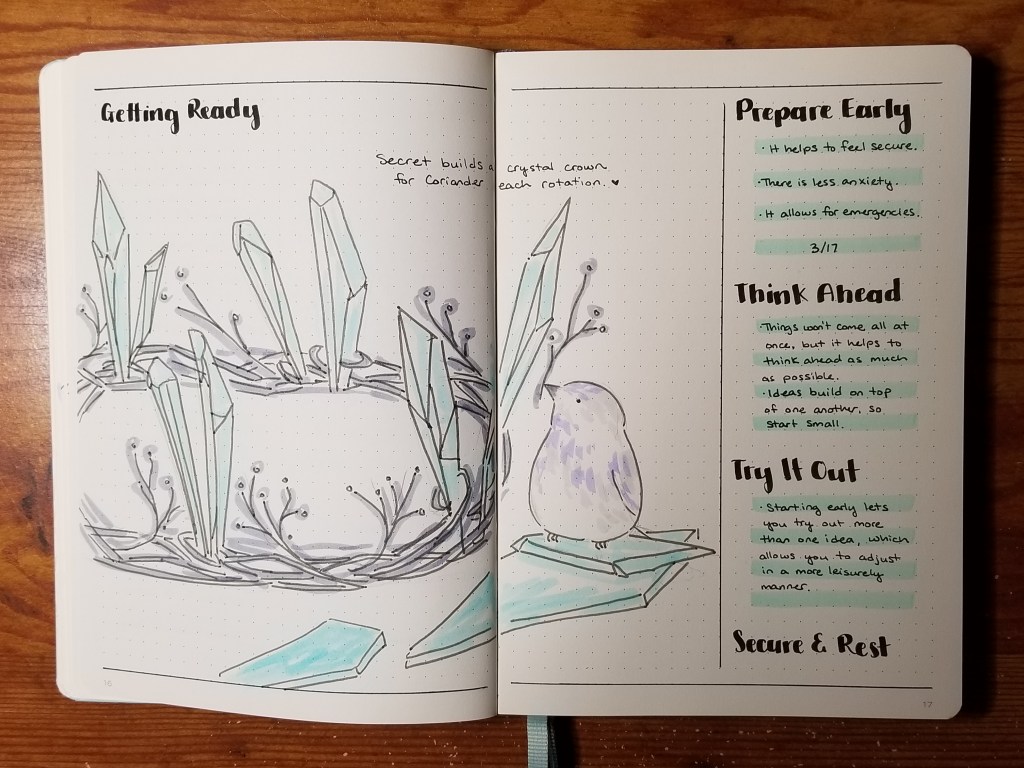
Bullet journaling is one of the few mediums that allows you to combine both writing plus illustration on the page in appealing and practical ways.
You do not need to be stellar with handwriting or hand lettering, though if you want to give calligraphy or hand lettering a go, feel free!
As long as you can see the benefit of putting your writing and your art on the double page open before you, you can create your own spreads, which is a bullet journal term.
Do you need to join an art community or a writing community or a bullet journaling community to do any one of these things?
Absolutely not.
Only if you want. If you’re squeamish, don’t suffer. Don’t join.
What matters most is that you… Catch! That! IP!!! Go!!!
In all seriousness, your IP is probably moving faster than you can catch it at this time. Later, we can go into maybe some of the basics of getting sketches and written notes on your pages properly, but first, everything on the page.
You decide what type of bound book you want to put them in.
Love,
Sarah
 Sarah Clarity Studios
Leave a comment